How Often Should Commercial Kitchens in Spokane Clean Their Exhaust Ducts?
- Maksim Palets
- Aug 21, 2025
- 4 min read

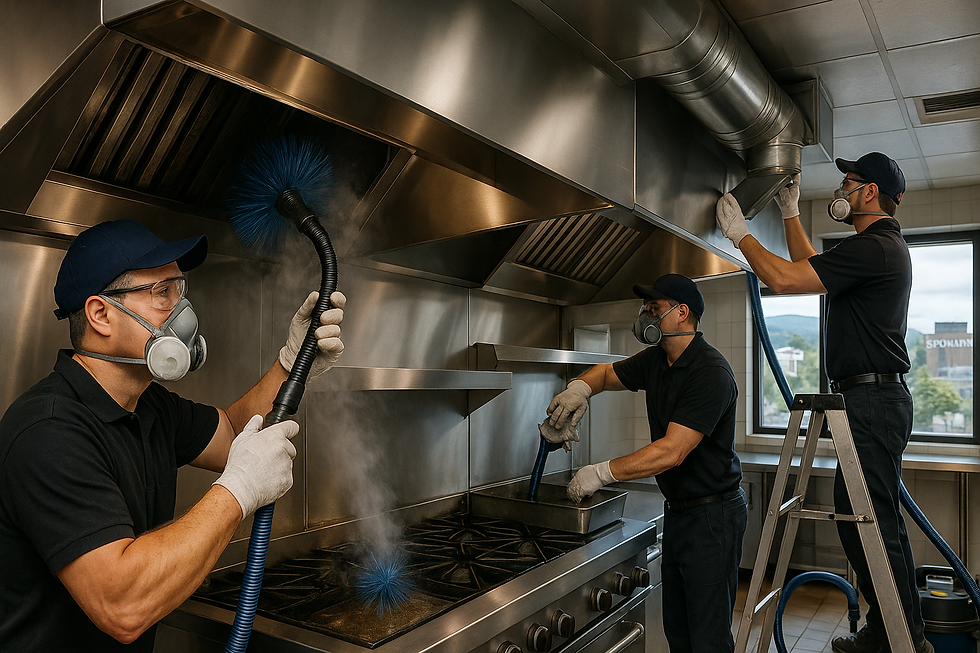
Commercial kitchens in Spokane operate under a tight blend of fire code, health requirements, and insurer expectations. At Air Duct Cleaning Spokane (Spokane, WA), we structure cleaning programs around the standards enforced locally—NFPA 96, the 2021 International Fire Code (IFC) as adopted in Washington and Spokane, and Spokane Fire Department practices—so kitchens pass inspection, avoid grease-fire risk, and keep airflow efficient.
Spokane’s Code Reality (What Actually Applies)
Washington adopted the 2021 IFC statewide on March 15, 2024. Local jurisdictions enforce it with their own amendments.
Spokane explicitly requires wet-chemical, UL-300–listed suppression for Type I hoods, installed per NFPA 17A, and ties kitchen systems to IFC Chapter 904.
The Spokane Fire Department maintains a database of range-hood suppression service reports, so staying on schedule is traceable.
“A wet chemical suppression system shall be installed in a commercial kitchen exhaust hood and duct system … tested in accordance with UL 300 … and installed in accordance with NFPA 17A.” — Spokane Municipal Code §17F.080.010
NFPA 96 Frequency: The Minimum Inspection Cadence
NFPA 96 sets minimum inspection frequencies for grease buildup; cleaning must follow if inspection finds combustible residue. Here’s the industry-standard cadence used by authorities having jurisdiction (AHJs) and insurers:
Type/Volume of Cooking | Minimum NFPA 96 Inspection Frequency* | Typical Spokane Examples |
Solid-fuel (wood/charcoal ovens, smokers) | Monthly | BBQ/smokehouse, pizza with wood-fired oven |
High-volume (24-hour, charbroil, wok) | Quarterly | Wok line, burger/charbroil chains |
Moderate-volume | Semi-annually | Standard full-service restaurant/hotel |
Low-volume (churches, day camps, seasonal) | Annually | Community halls, seasonal concessions |
*NFPA 96 “Table 11.4” language is widely referenced by fire authorities.
Don’t Confuse Inspection With Cleaning
NFPA 96 prescribes inspection intervals; cleaning is required whenever combustible residue is present to return surfaces to acceptable cleanliness (commonly “to bare metal” in practice).
Why Staying on Schedule Matters (Data You Can Use)
Restaurant fire risk is real: historical NFPA research found roughly 7,410 structure fires per year in eating and drinking places (2010–2014), with cooking equipment in 61% and “failure to clean” a factor in 22% of incidents.
More recent national snapshots show over 9,000 restaurant fires annually (2017–2021) in the U.S., causing $175M+ in direct property damage per year.
Spokane Factors That Can Shorten Your Interval
Spokane’s air is frequently influenced by wildfire smoke in late summer and fall, which can load rooftop make-up air filters and affect fan performance between scheduled services:
In a recent year, Spokane logged hundreds of “Good” air-quality days but also extended Moderate and periodic Unhealthy for Sensitive Groups periods during wildfire season.
Public-health advisories note that wildfire smoke regularly drives particulate spikes that affect indoor environments.
Operational takeaway: Higher particulate loading can prematurely clog filters and strain fans, which often nudges kitchens toward earlier hood/duct service ahead of winter menu changes.
What Inspectors, Fire Marshals & Insurers Expect in Spokane
UL-300 wet-chemical suppression under the hood, installed and maintained per IFC 904 / NFPA 17A.
Semi-annual suppression inspections by a licensed fire-protection contractor (this is separate from hood/duct cleaning).
NFPA 96–compliant hood/duct inspection & cleaning records (tags, date-stamped photos, and a service report the Fire Prevention Bureau can log).
Access panels, hinged fans, and full system reach (hoods, filters, plenum, vertical/horizontal ducts, rooftop exhaust).
Spokane-Ready Service Cadence (Examples We Implement)
Wok/charbroil line (downtown, 14–16 hrs/day): Inspect quarterly, but pre-book monthly during peak periods if residue accumulates faster (especially late summer). Clean at each inspection when residue is present; coordinate semi-annual suppression the same week for operational efficiency.
Hotel banquet kitchen (moderate volume): Semi-annual NFPA 96 inspections; often one or both visits result in cleaning. Add a make-up air filter swap just before wildfire season.
Seasonal venue/church kitchen: Annual inspection timed before the busy season, with cleaning as needed, and document reports for the AHJ.
Evidence-Based Practices Between Cleanings
Follow ANSI/IKECA best-practice standards (C10 cleaning, I10 inspection, M10 maintenance) for measurable cleanliness and documentation beyond NFPA 96’s minimums.
Replace/clean baffle filters and make-up air filters on a fixed schedule during wildfire season to preserve capture and keep ducts cleaner between professional services.
Compliance Checklist for Spokane Managers
Verify code basis: IFC 2021 statewide adoption plus applicable Spokane amendments.
Set NFPA 96 intervals: Use the monthly/quarterly/semi-annual/annual framework; clean whenever residue is present.
Book suppression inspections: Every 6 months with a licensed contractor; ensure UL-300 documentation remains current.
Keep records: Tag, photo, and archive all service reports; Spokane Fire maintains a database for audits.
CONCLUSION
We design Spokane kitchen exhaust programs around NFPA 96 inspection intervals, the IFC/Spokane code requirements, wildfire-season realities, and insurer expectations. That means documented inspections at the NFPA frequency for your cooking type, cleaning whenever residue is present, semi-annual suppression service, and proactive filter maintenance during smoke season—so you stay safe, compliant, and efficient year-round.
For a quick pre-sale boost, discover why agents recommend pre-summer duct cleaning in this post.
FAQs
1) Is NFPA 96 telling me how often to clean or how often to inspect?
NFPA 96 sets minimum inspection frequency by cooking type; cleaning is required whenever combustible residue is found (often described as cleaning “to bare metal”).
2) What else—besides hoods and ducts—has a fixed cadence?
Your hood suppression system needs a 6-month inspection by a qualified contractor, independent of duct cleaning, and Spokane requires UL-300 wet-chemical systems on Type I hoods.
3) Who enforces this in Spokane and what paperwork should I keep?
The Spokane Fire Department Fire Prevention Bureau reviews service-report records for range-hood suppression and other systems. Keep tags, dated photos, and service reports ready for the AHJ and insurers.


Comments